Ice Maker Repair
An Ice Maker Being Starved Looks Exactly Like One That Has Failed
Copy by Rosalind Okafor Refrigeration technician — dual-refrigeration and column units · 22 years in the trade
Treats a dual-refrigeration cabinet as two machines that happen to share a door line, and diagnoses the halves separately. The evaporator that frosts and the one that never does are rarely failing for the same reason.
EPA 608 certified
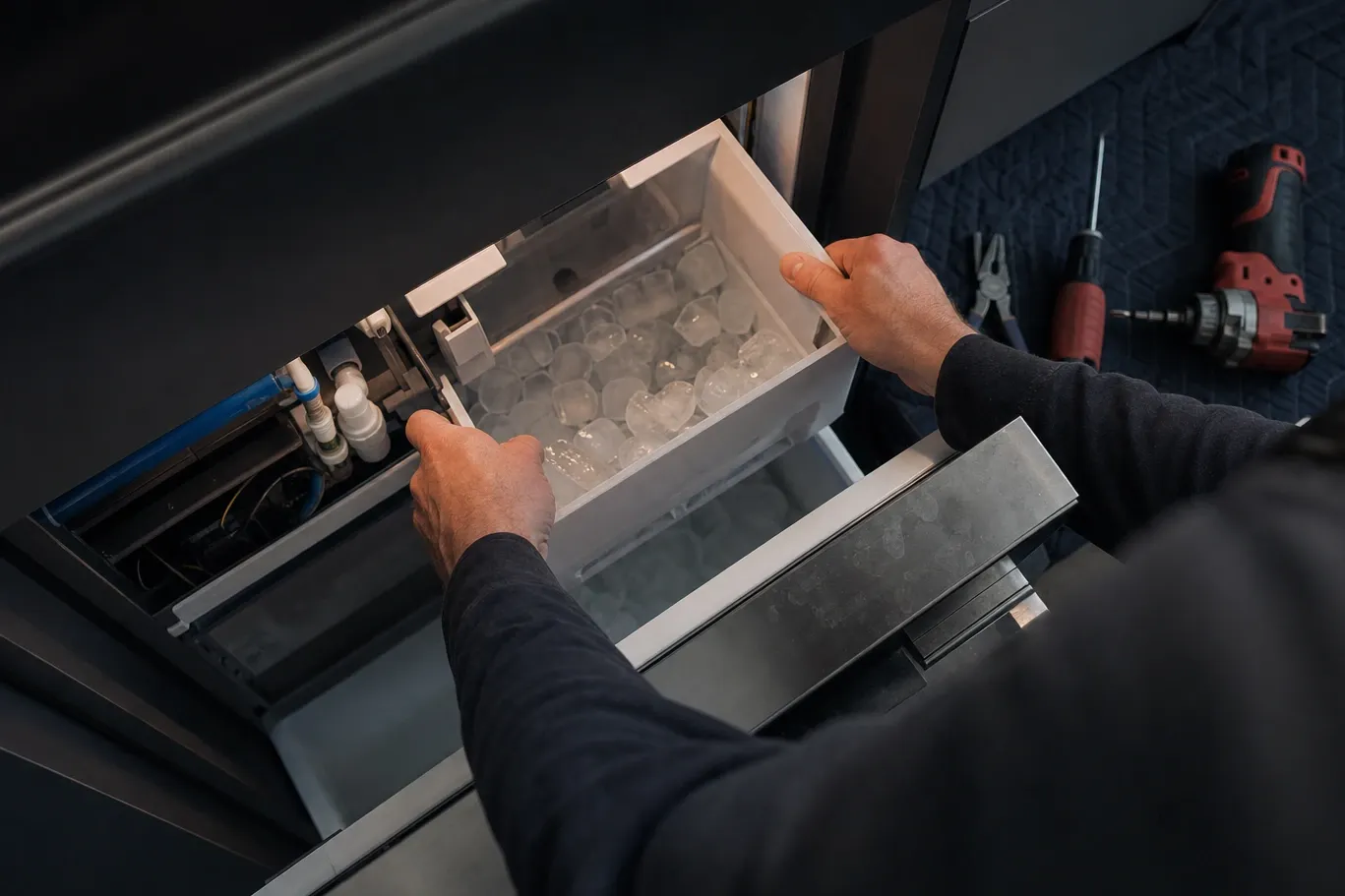
Ice calls in tower kitchens follow a pattern. The bin is empty, or the cubes are coming out small and hollow and fusing into a slab, and the module has already been blamed by everyone who has looked at it — because it is the part you can see, and it is the part with a moving arm on it.
The trouble is that a module being starved of water behaves identically to a module that has failed. Same empty bin, same undersized cubes, same silence between cycles. In a building where the water reaches your kitchen after a long internal run, through a shut off you have never seen, a filter of unknown age and a valve at the back of a cabinet nobody has pulled out in years, starvation is the more likely of the two by a distance.
What a cube tells you before anything else does
Look at what the machine is actually producing, if it is producing anything.
Small, hollow cubes with a dimple or an open centre. The mould was not filled to the top before the cycle froze and harvested. That is a fill problem: not enough water, or not enough time spent filling.
Cloudy or white cubes that are otherwise full size. The freeze is happening too quickly for the water to give up its dissolved air and minerals, or the water arriving is heavily mineralised. On a clear-ice module this often points at the drain or the circulation side rather than the fill.
Cubes fusing into a slab in the bin. They are melting and refreezing, which is a bin temperature problem, not a fill problem — worth separating out, because it sends the diagnosis somewhere completely different.
Nothing at all. The least informative result, and the one that needs the fill test below.
Time the fill yourself
This is the single most useful thing you can do before anyone arrives, and it needs a phone with a stopwatch on it.
Empty the bin, make sure the shut-off arm is down or the bin sensor is clear, and wait for a cycle to start. When you hear water running, start timing. Most modules fill for somewhere between five and ten seconds; what matters is not the exact number but whether the fill sounds strong and stops cleanly, or whether it trickles, stutters, or runs on much longer than that as if the machine is waiting for water that is not coming.
Then look at where the water went. Water that has run down the back wall of the compartment and frozen into a ridge means the fill tube is misaligned or partly frozen — the machine is filling and missing. Water in the mould but only halfway up means the fill is short. No sound of water at all means nothing is being delivered, and the fault is upstream of the module entirely.
Write down what you observed. That description alone often decides which parts come out on the visit.
Everything upstream, in the order it gets checked
In a high-rise the supply story is longer than it is in a house, and every element of it can throttle the machine.
The building riser and your own shut-off come first. Undercounter ice makers are frequently fed from a valve inside a cabinet or behind a panel that was closed to three-quarters during some other piece of work years ago and never reopened.
The filter is next. Age matters more than appearance: a cartridge that looks fine can be loaded enough to drop the flow below what the module needs, and there is no indicator on most installations to tell you that has happened.
Then the line itself. Long runs inside joinery get compressed behind a cabinet that was pushed back too far, and a saddle tap — still common on older installations — can be partly seized or never have been fully opened in the first place.
Last comes the inlet valve on the machine, which is where the pressure reading is actually taken. A valve with a strainer full of scale passes a trickle and behaves in every observable way like a valve that has failed, and the two are distinguished with a gauge rather than by argument.
Where scale fits into this
Chicago water is drawn from the lake and treated to a hardness that is moderate rather than extreme — nothing like the water in the desert metros — but it is not soft, and scale accumulates anywhere water is repeatedly warmed, evaporated or left standing.
On a clear-ice module that shows up in the trap and the drain line as much as at the valve, and the practical consequence is a cycle that has changed its timing: slightly slower fills, slightly longer freezes, cubes that have quietly got smaller over two years without anybody noticing until they stopped being useful.
That gradual change is worth mentioning if you have seen it. A machine that has been declining slowly and a machine that stopped last Tuesday are usually two different faults, and the first one is far more likely to be supply-side.
When the module really is the answer
It does happen, and it has a signature.
A harvest cycle that starts and stalls partway, with a grinding half-turn every couple of hours, is mechanical. A module that fills correctly — you timed it, the mould filled, the water went where it should — and then never harvests is mechanical. A module that has water at the valve with good pressure and produces nothing is mechanical.
Every one of those conclusions depends on having ruled out the water first, which is why the pressure at your inlet valve and the fill volume over a complete cycle are the first two readings taken on this call and not the last two. It is five minutes of measurement, and it decides whether the job is a valve, a filter and a length of line, or a module.
Follow-up questions
- The bin is completely empty. Surely that is the module?
- It might be, but an empty bin is the least specific symptom an ice maker produces. No fill, a stalled harvest, a shut-off arm that has been knocked down, a frozen fill tube and a closed valve all produce exactly the same empty bin. The order the readings are taken in matters more than the symptom does, and water comes first because it is the cheapest thing to rule out.
- I changed the filter and nothing improved. Does that rule water out?
- No. A new filter rules out one restriction among several. The valve itself, a partly closed shut-off, a kinked line behind the cabinet, a saddle tap that was never fully opened and low pressure at your riser all sit upstream or downstream of the filter and are unaffected by changing it.
- Can I test the water myself?
- Partly, and it is worth doing. Time how long the machine runs water during a fill, and look at the size and shape of the cubes it does produce. Both of those are real measurements. What you cannot do without a gauge is read the static and running pressure at the inlet valve, which is the number that separates a starved machine from a failed one.