Refrigerator Repair
Getting a Sub-Zero Into a Chicago Lakefront High-Rise: Freight Elevators, COIs and 1920s Service Cores
Copy by Rosalind Okafor Refrigeration technician — dual-refrigeration and column units · 22 years in the trade
Treats a dual-refrigeration cabinet as two machines that happen to share a door line, and diagnoses the halves separately. The evaporator that frosts and the one that never does are rarely failing for the same reason.
EPA 608 certified
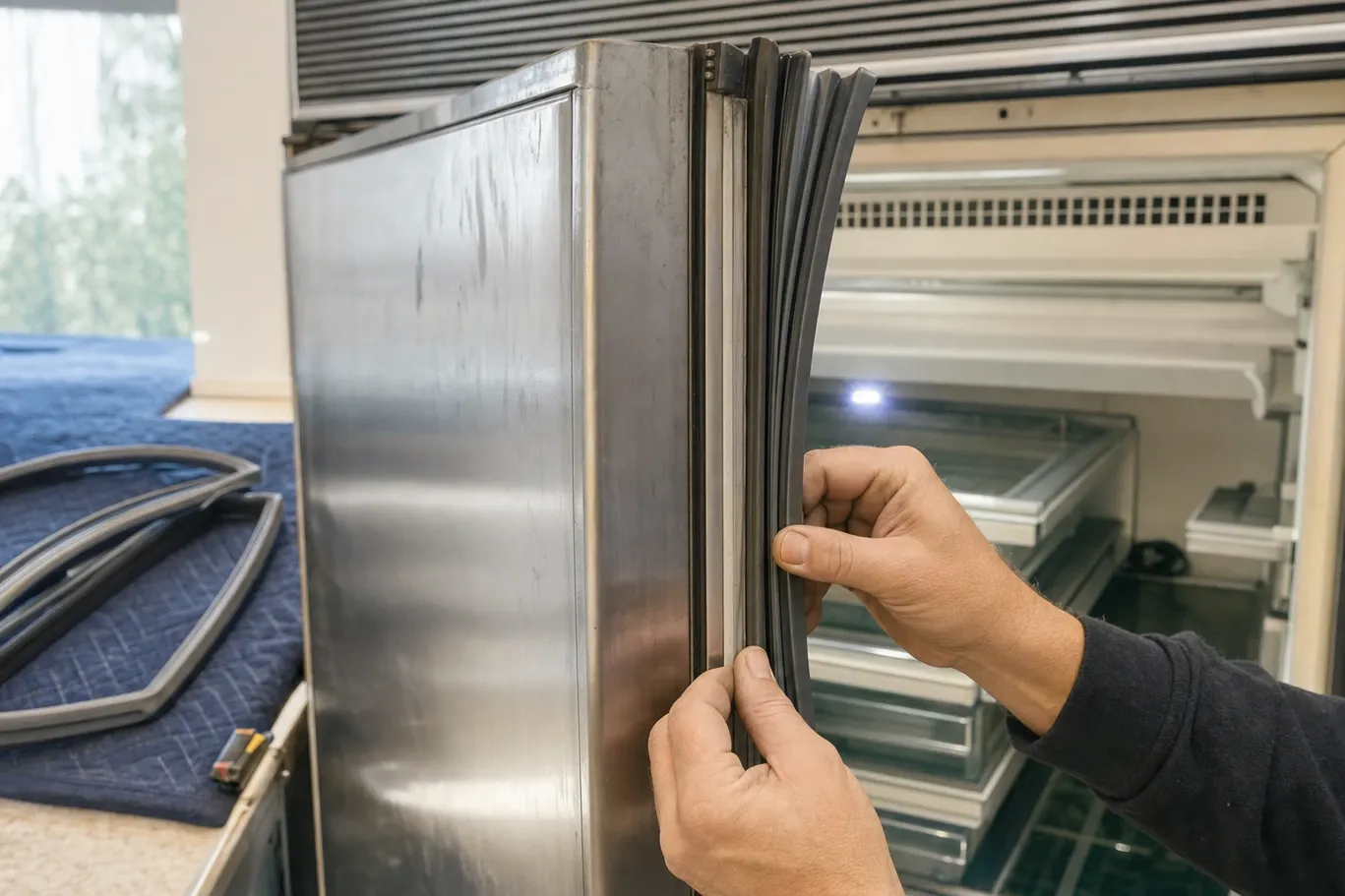
In a lakefront tower, the refrigerator is not really an appliance problem until it is a building problem. Whether a Sub-Zero column can be repaired in place, swapped, or replaced at all is decided by a dock schedule, an elevator reservation and an insurance certificate — none of which the homeowner controls.
Getting the appliance in at all
A full-height Sub-Zero built-in cannot ride a passenger car, and it will not turn on a residential stair. It reaches the kitchen through the loading dock and the reserved freight or service elevator, during the move hours the association permits, with a contractor’s certificate of insurance already on file. That paperwork outranks everyone’s calendar.
This is the ordinary condition across most of this service area rather than an edge case. NeighborhoodScout’s profile of Streeterville puts 99.5% of its residential real estate in large apartment buildings and high-rises, and Homes.com describes the same neighbourhood at roughly 76,952 people per square mile — denser than 99.3% of American neighbourhoods. Lakeview East reads the same way a block off the water. The Gold Coast mixes towers with pre-war co-ops and mansion flats. Lincoln Park is the outlier: greystones and brick three-flats where a truck can sit at the kerb and the route to the kitchen is a front door and a hallway.
What Chicago makes difficult
The hard part is the age of the service core, not the age of the cabinet. Alongside the Gold Coast, the East Lake Shore Drive District — designated a Chicago Landmark on April 18, 1985 — is a row of eight luxury apartment buildings put up between 1912 and 1929 by Marshall & Fox and Fugard & Knapp. Those back halls were laid out for iceboxes and service carts.
What that means in practice is that the constraint is rarely the kitchen. It is the turn out of the service lobby, the width of the back hall, the swing of a pantry door that was hung when the room behind it was a butler’s pantry, and a threshold nobody has looked at since. A cabinet that fits its opening beautifully can still be undeliverable, and the point at which that becomes obvious should never be the morning of the delivery.
The decisions that get made on install day
Measure the narrowest point on the route, not the doorway. Crate width, hinge-side clearance, whether the doors and handles come off, whether the unit can be tipped at all, and how much depth the cabinet needs behind the grille for the compartment to breathe — those five answers, taken in that order, decide whether the day works.
Two of them come back to haunt people. The first is the finished opening: joinery built tight to the cabinet with no service reveal means every later repair starts with cabinetry work. The second is the water feed for an ice maker, which in a tower runs a long way inside the building before it reaches a valve you can actually shut. If nobody notes where that valve is on install day, somebody hunts for it later with a wet floor.
Photograph the model and serial plate while the grille is off, and write down which floor the shutoff lives on. Both are free that morning and expensive to reconstruct.
What that costs you two years later
Most faults are component faults, and component faults stay inside the apartment. Door gasket or seal replacement runs $290 to $650. An evaporator or condenser fan motor is $320 to $710. Defrost heater, thermostat or sensor work sits between $270 and $670, ice maker, water valve or supply line between $280 and $850, and an electronic control board between $410 and $990. None of that needs a dock.
The exception is the sealed system. A compressor or sealed-system repair is $1,460 to $3,360, and if the verdict is a whole-cabinet replacement instead, the building routine restarts: elevator booking, insurance certificate, protection of the lobby and corridor, disposal of the old unit down the same single route it came up. In a 1912-to-1929 building that is a scheduling exercise measured in weeks, not a morning. It is the strongest argument for diagnosing early, while a fault is still a part.
What to ask before the delivery is booked
Ask the management office six things: what the dock hours are, how far ahead the service elevator has to be reserved, who must be named on the certificate of insurance and for what limits, whether corridor and lift protection is required, whether there is a stair or threshold on the route, and what the measured clear width is at the tightest turn. Get the last one as a number from someone who has held a tape to it.
Then hand those answers to whoever is doing the work before the appliance is ordered. A diagnostic visit here is $89, and on a tower job it is worth booking early precisely because it produces a written verdict you can take to the board rather than a guess you have to defend. Ring (312) 964-8834 and describe the symptom in the order it happened.
Follow-up questions
- Does a repair visit need a certificate of insurance, or only a delivery?
- Most Chicago buildings ask for one from any contractor working on the premises, though the requirement is usually lighter for a hand-carried repair than for a dock delivery. Ring the management office before the appointment and ask who must be named and at what limits. It takes a day to arrange and can otherwise stop a technician in the lobby.
- Our freight elevator is booked weeks ahead. Can the diagnosis still happen sooner?
- Usually yes. A diagnostic visit and most component repairs need nothing more than the passenger lift and a tool bag, because the parts involved are small. The reservation matters when a whole cabinet moves in or out. That is the argument for diagnosing early: you learn which category you are in while there is still time to book the dock.
- The unit is already in the apartment but will not come out of its opening. What now?
- That is a joinery problem before it is an appliance problem. Built-ins fitted tight into cabinetry with no service reveal often need the surround, the plinth or a filler panel removed before the unit will slide forward. We assess it on the diagnostic visit and say whether a cabinetmaker should attend first, so nobody forces a panel that was scribed in place.